A right to light is a legal easement you can enforce. A right to a view, in almost every case, is not.
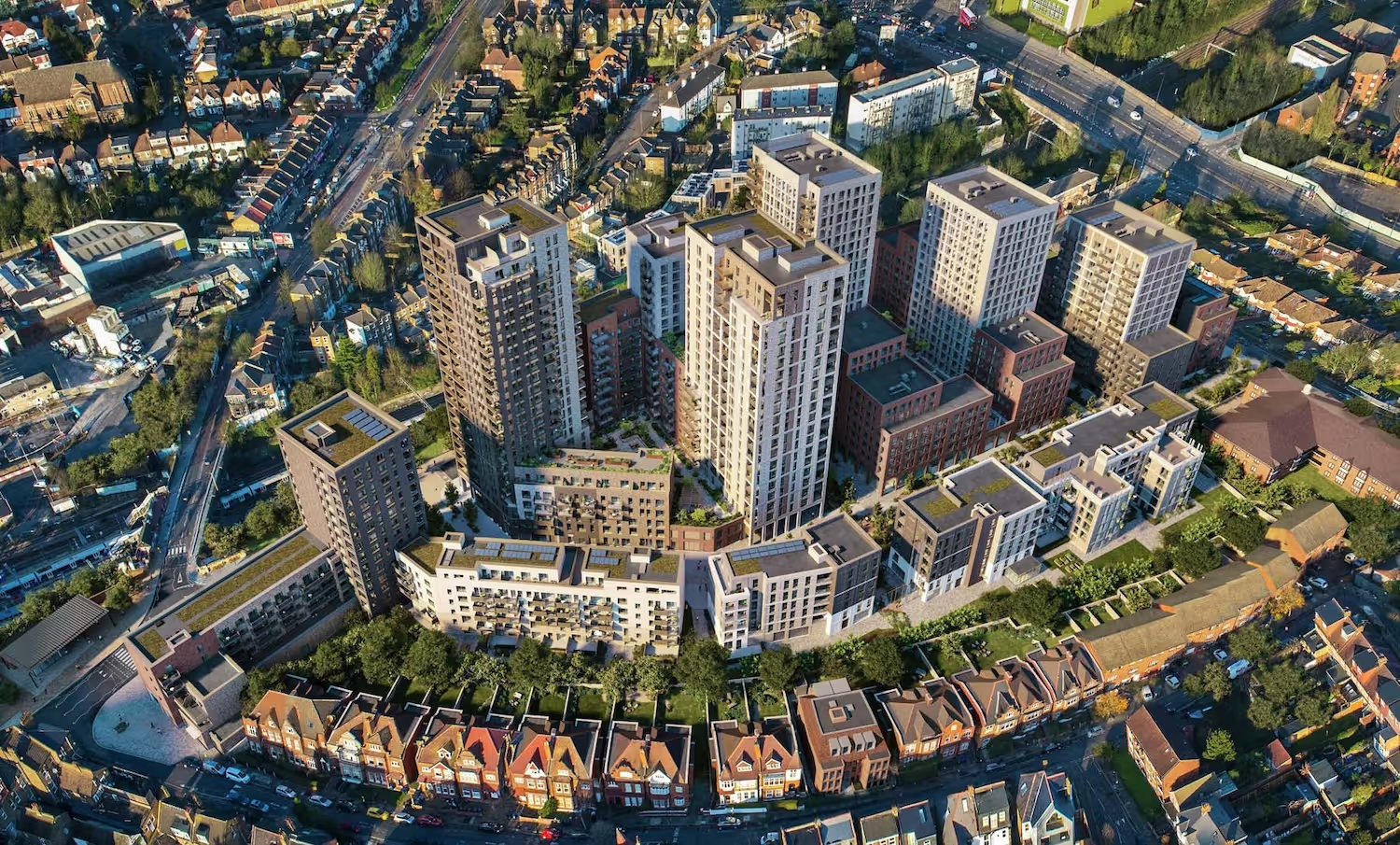
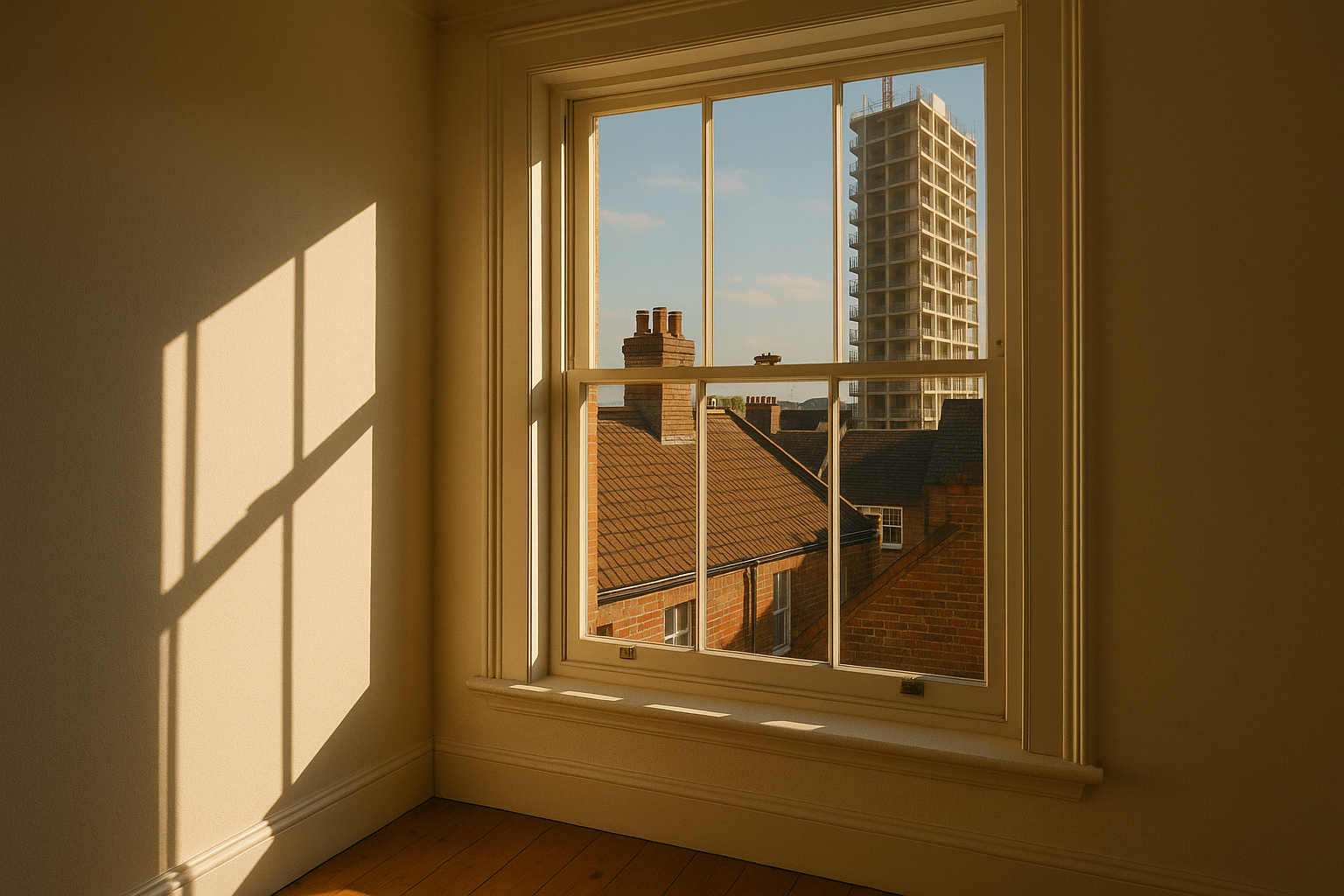
That single distinction catches people out more than any other in this area. You look out of a first-floor window across open sky, a stretch of garden, perhaps a line of rooftops you have watched for twenty years. Then a development goes up and takes it. The instinct is that something you owned has been stripped away. The law sees it differently, and the difference between a right to light and a right to a view decides whether you have anything to enforce at all.
- Light is a recognised easement in England and Wales, protected by long use.
- A view is not an easement and, with rare exceptions, cannot be protected at all.
- The same development can lawfully spoil your view while unlawfully cutting your light.
What is a right to light, and why is it protected?
A right to light is a private easement: a property right attached to a specific window or opening that lets a defined amount of natural light reach a room. It is not a general entitlement to brightness. It is a measurable easement over a neighbour's land.
Most rights are acquired by long use under the Prescription Act 1832. If a window has enjoyed light across neighbouring land for twenty years without interruption or written consent, the right crystallises. Section 3 of that Act sets out the mechanism. You can read the exact wording on legislation.gov.uk.
The law protects light because it is essential to the ordinary use of a building. A room too dark to work or live in is a room diminished in value and function. The courts have measured that harm for well over a century, ever since Colls v Home and Colonial Stores Ltd [1904] AC 179 set the test of sufficient light for ordinary purposes.
Why isn't a view protected in the same way?
A view is not protected because English law has refused, for centuries, to recognise it as a property right. The leading authority is old but unmoved: in Wheeldon v Burrows (1879) 12 Ch D 31 and the cases around it, the courts treated a prospect over a neighbour's land as too vague and too burdensome to bind that land.
The reasoning is practical. Light falls on a fixed window from a fixed direction and can be measured. A view is open-ended. If your outlook across a field were a right, your neighbour could never build, plant a tall tree, or change anything within sight of your window. That would freeze land use across a whole neighbourhood on the strength of what one person happens to look at.
So the law drew a hard line. Light in, protected. Outlook, not.
Can a view ever be protected?
Occasionally, and only by express agreement rather than by long use. A view can be preserved through a restrictive covenant, a clause in a contract or transfer deed that limits what a neighbouring owner may build.
If a developer sold you a plot and promised in writing that the land opposite would stay open, that promise may bind the land as a covenant. It is a contract right, not an easement, and it depends entirely on the words used and whether the burden was properly attached to the neighbouring title. There is no default protection. If nobody wrote it down, it almost certainly does not exist.
Planning is the other route people reach for, and it is weaker than they hope. A local authority may consider the effect of a scheme on outlook and amenity, but a planning refusal is a matter of public policy, not a private right you can enforce. Even a granted permission does not authorise interference with a private easement, a point worth understanding before you assume planning permission settles anything about your light.
The same window can win on light and lose on view
Here is the situation that surprises people most. A new building goes up. It ruins the open outlook from your sitting room and it also darkens that room. You have no claim for the view. You may well have a strong claim for the light.
The two are assessed on completely separate footings. The view is gone and the law shrugs. The light is measured with a Waldram analysis, which maps how much of each room still receives adequate sky light after the obstruction. If enough of the room falls below the accepted threshold, the injury is actionable regardless of what the room now looks out onto.
This is why we tell owners to separate the two feelings from the start. The loss of a cherished view is real and worth naming, but it does not drive a claim. The loss of measured light does. Focusing on the outlook can send a strong case in the wrong direction.
How the light claim is actually valued
Once light injury is established, the remedy is either an injunction or damages. The court chooses between them using the framework from Coventry v Lawrence [2014] UKSC 13, which reworked the older test and gave judges wider discretion to award damages instead of ordering a building cut back.
Damages themselves are rarely a simple book value of the light lost. Where a developer has profited from the obstruction, courts have awarded a share of that profit as the price of releasing the right, an approach seen in Tamares (Vincent Square) Ltd v Fairpoint Properties (Vincent Square) Ltd [2007] EWHC 212 (Ch). The negotiating leverage that produces those figures comes from the credible prospect of an injunction, not from the view you have lost. If you want the fuller picture, we set it out in our note on how compensation is really calculated.
None of this reaches into the outlook. A court will not add a penny because the scheme also spoiled your prospect. That element simply falls away.
Common questions
My estate agent said the property had protected views. Does that mean anything?
Almost certainly not, unless there is a registered restrictive covenant on the neighbouring land in your favour. Marketing language about protected views is usually describing the current outlook, not a legal right. Check the title documents. If no covenant exists, there is nothing to enforce when the outlook changes.
A tall tree next door blocks my view and my light. Can I do anything?
Not through a rights of light claim. An easement of light protects against buildings and structures, and the courts have never extended it to trees, hedges or other planting. High hedges may fall under separate local authority powers, but that is a distinct process and has nothing to do with a private easement.
If I have no claim for the view, is it worth getting the light assessed at all?
Often, yes. The two are independent. Owners who assume the whole loss is about the view frequently walk away from a valuable light claim sitting underneath it. A short rights of light analysis tells you whether the measured light injury crosses the threshold, and it costs you nothing to find out under a funded arrangement.
What to do if a development threatens your window
Start by separating the two questions in your own mind. Ask what you are losing in outlook, and accept that the law will not help with that part. Then ask, separately, whether the same building will darken your rooms.
Get the light measured before the scheme completes, because your position is always strongest while the building can still be adjusted and weakest once it stands finished and occupied. Delay narrows the remedies a court will entertain, as the history of these cases shows. A funded rights of light analysis will tell you plainly whether the measured injury is there.
If it is, you have something to enforce. If it is only the view, we will tell you that too, and save you the cost of chasing a right that does not exist.
This article is general information about the law in England and Wales, not legal advice. Outcomes always depend on the facts.
Joshua Platt BSc (Hons) MRICS, Director, Daylight Protect
Daylight Protect is a rights of light claims specialist operating across England and Wales. We provide a fully funded solution that covers everything end to end, the surveyor, the right of light solicitor, counsel and court fees, backed by legal insurance that covers the developer's costs if a claim does not succeed. There is no recovery, no fee, and no costs to you either way. We tell you plainly when you have a claim, and just as plainly when you do not.
Similar insights